On this page
Short answer: Common ways to pay for foundation repair include personal loans, home equity loans, cash-out refinancing, credit cards and contractor financing (Bob Vila). Compare the total cost, interest and fees before you borrow. This guide explains foundation repair financing.
This guide explains foundation repair financing. Reviewed by: Hassan Ifthakir, civil engineer (BSc Civil Engineering, COMSATS University, Abbottabad). Last updated: November 2026. This is general information, not expert advice. Large, growing, or structural cracks need a licensed structural engineer.
Homeowners usually pay for foundation repair from savings, through a contractor’s payment plan, or with borrowing secured on the home, such as a home equity loan or line of credit. Personal loans and credit cards are also used, usually at higher cost. Insurance rarely pays for settlement-related repairs, but it is worth checking your policy. This guide describes the options in general terms; it is not financial advice, and the right choice depends on your situation.
For how much repairs cost and why, see foundation repair cost. More cost guides are in Costs and Pricing.
Foundation repair financing: Before you look at financing
The best way to keep borrowing down is to make sure the repair itself is the right size:
- Get a clear diagnosis, ideally with an engineer’s report for larger repairs
- Get written quotes for the same scope. Estimate, not a quote. Get 3 quotes.
- Ask whether the work can be phased, such as drainage now and piers later, and what the risk is in waiting
Repair cost range: $2,200 to $8,100 for most jobs, with an average near $5,200 (HomeAdvisor and Angi, 2026). Estimate, not a quote. Get 3 quotes.
Common ways to pay
Savings
Paying from savings avoids interest and loan fees. Some homeowners combine savings with a smaller loan.
Contractor payment plans
Some repair companies offer financing, often through a third-party lender. Terms can include deferred interest, promotional rates, or fixed monthly payments. Read the agreement carefully: deferred interest promotions can charge all the interest back if the balance is not paid in full by the deadline.
Home equity loan or line of credit
A home equity loan gives a lump sum at a fixed rate, while a home equity line of credit (HELOC) lets you draw as needed, often at a variable rate. Both use the house as collateral, which typically means lower rates than unsecured loans but the risk of losing the home if payments are missed.
Cash-out refinance
Replacing the mortgage with a larger one and taking the difference in cash. This changes the terms of your whole mortgage, so compare total cost carefully.
Personal loans
Unsecured personal loans do not use the home as collateral. Rates and terms vary with credit history and are often higher than home equity borrowing.
Credit cards
Credit cards are easy to use but often carry high interest unless paid off quickly or used during a promotional period.
Government and local programs
Some states, cities and nonprofit groups offer home repair loans or grants for eligible homeowners, such as older residents or lower-income households. Check with your state or local housing agency for current programs and eligibility. Check with your local housing agency.
Insurance
Standard homeowners policies commonly exclude damage from settlement, soil movement and long-term leaks, but coverage varies. A sudden event, such as a burst pipe, may be treated differently. Ask your insurer in writing.
What to compare between offers
- The annual percentage rate (APR) and whether it is fixed or variable
- The total amount repaid over the full term
- Fees: origination, prepayment, late payment
- Promotional terms and what happens when they end
- Whether the home is used as collateral
- How payment is released to the contractor, ideally tied to completed work
Red flags in repair financing offers
- Pressure to sign financing the same day as the inspection
- A monthly payment quoted without the APR or total cost
- Deferred interest terms that are not explained in writing
- A loan arranged through the contractor that pays the contractor in full before work starts
- Blank fields in the agreement, or terms that differ from what was said
- Requests to sign a completion certificate before the work is finished
If anything is unclear, take the documents home and read them before signing. You can also compare the offer with what your own bank or credit union would provide for the same amount.
Paying the contractor
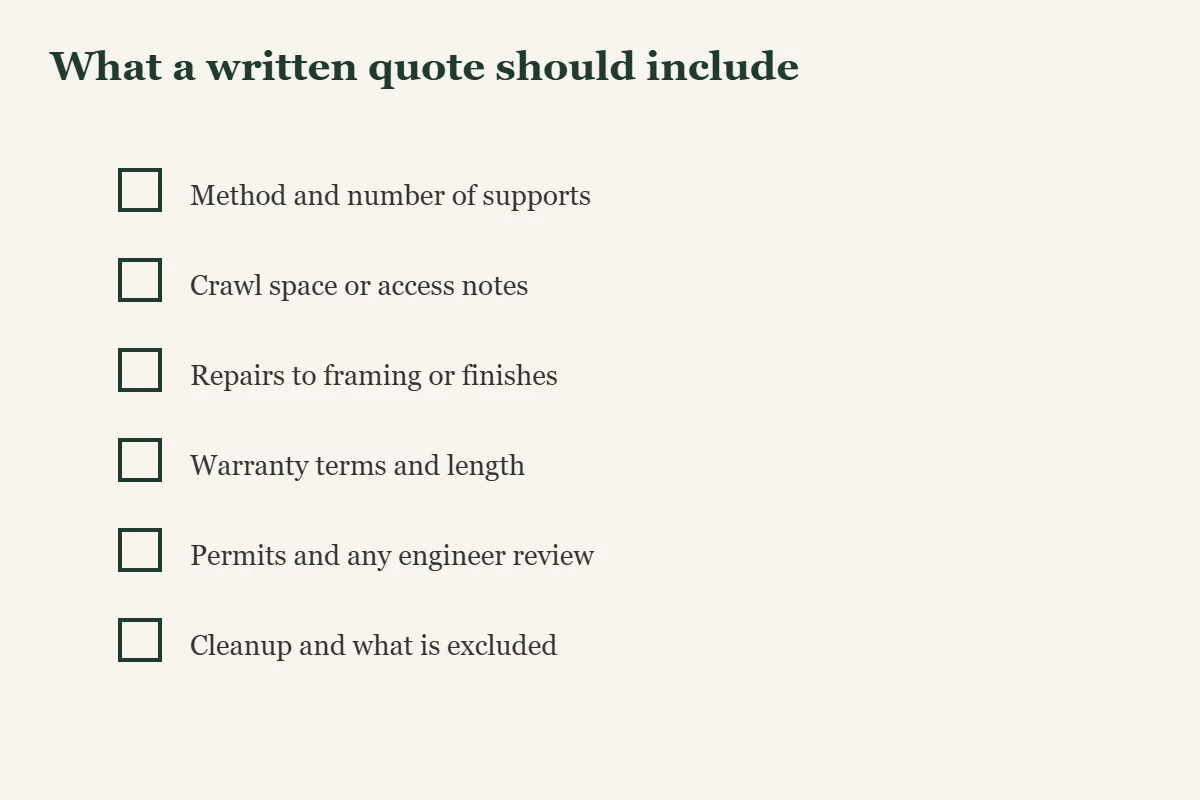
Avoid paying the full amount upfront. A common structure is a deposit, a payment at a defined stage, and the balance after completion and final inspection. Get the payment schedule in the written contract. Our quote comparison guide covers what the contract should say.
Frequently asked questions
Can I finance foundation repair with bad credit?
Options may be more limited and more expensive. Secured options, local assistance programs and contractor plans each have different requirements. Compare total costs before signing.
Does foundation repair add value to my home?
A documented repair with a transferable warranty can help when selling, compared with an unrepaired problem. Keep all reports, permits and warranty papers.
Should I tell my lender about a foundation repair?
If you are borrowing against the home, the lender may ask about its condition. Keep repair reports, permits and warranty papers ready, since they help show the problem has been addressed.
Is it better to wait and save up?
That depends on how fast the house is moving. Ask an engineer or inspector what the risk of waiting is; delay can make the repair larger. See foundation repair cost per pier for how the scope sets the price.
Prices as of November 21, 2026, source: Angi (2025 data); Modernize (2026); HomeAdvisor (2026); HomeGuide (2026); This Old House (2026); Fixr (2026)